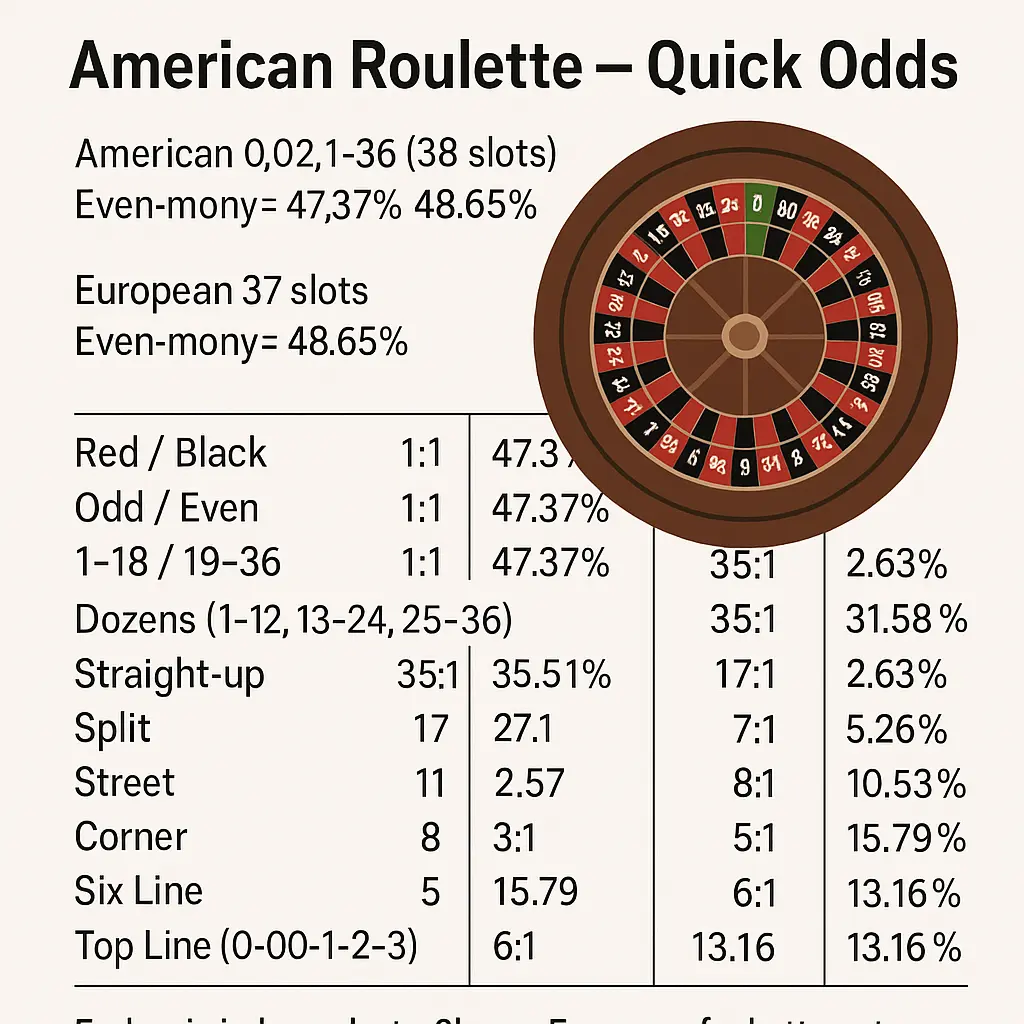
Experienced roulette dealers cannot make the ball hit any single number at will, but some can steer it toward a contiguous sector of the wheel. Facing such dealers, most players will lose over time. When you see a high-roller miss hand after hand, luck may be part of it—but the dealer’s steering can also matter. Be cautious around dealers who seem highly practiced.
The good news: if a skilled dealer can “set up” players, a savvy player can sometimes set up the dealer. Below are two methods—the first for beginners, the second for more advanced players.
I. A Beginner’s “Trap” for an Experienced Dealer
Divide the wheel into seven zones:
-
Zone 0: 0 and 00
-
Zone 1: 1–6
-
Zone 2: 7–12
-
Zone 3: 13–18
-
Zone 4: 19–24
-
Zone 5: 25–30
-
Zone 6: 31–36
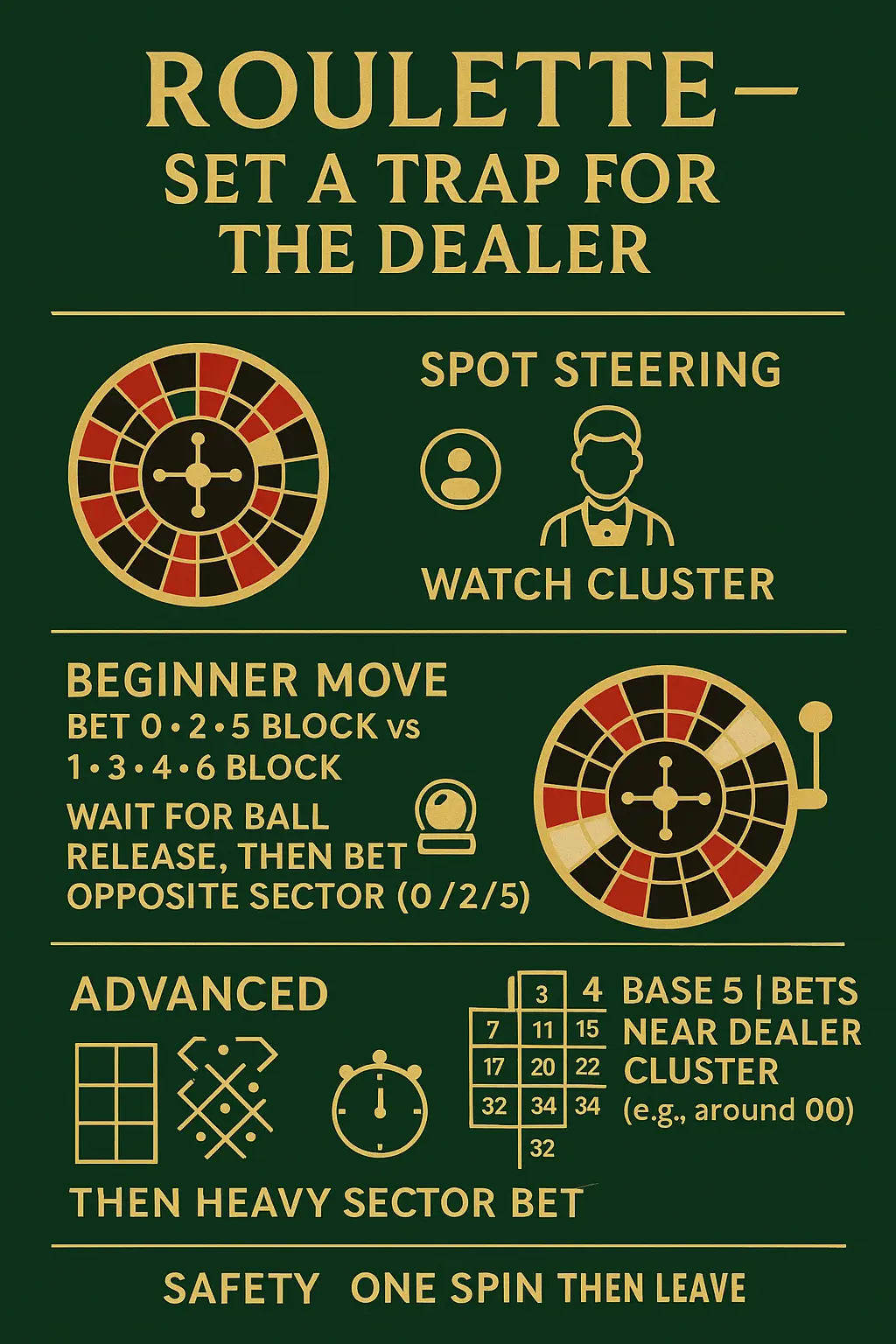
Note that Zones 0, 2, and 5 are not only adjacent on the betting layout (each is a “six-line” bet) but also form two contiguous arcs on the physical wheel to the right of 0/00. For our purposes, think of the wheel as two big blocks:
-
Block A: Zones 0 + 2 + 5
-
Block B: Zones 1 + 3 + 4 + 6
What to watch for:
If a big bettor keeps piling chips on Block B (Zones 1,3,4,6) and the ball keeps landing in Block A (Zones 0,2,5), that often signals a seasoned dealer who can steer into that sector and avoid the player’s numbers.
Your move next spin:
If the same player again loads up on Block B, do the opposite and bet heavily on Block A—i.e., on 0/00, the second six-line (7–12), and the fifth six-line (25–30).
Important: Place your heavy bet only after the dealer has released the ball; if you show your hand early, the dealer may counter.
When the table is quiet:
If there are no other players (usually a reason for beginners to leave), you can test the dealer by repeatedly betting within Block B. If the ball lands in Block A three times in a row, the dealer is likely skilled. On the next spin, start by spreading chips in Block B, then switch and drop a heavy bet on Block A after the ball is released. Win or lose, leave the table afterward—playing long against such dealers is risky.
II. An Advanced “Trap” for an Experienced Dealer
“Advanced” here means you know the wheel’s number order and can bet quickly.
When you’re the only player (again: tread carefully), use this low-cost coverage pattern as a base:
-
Place five corner bets on the intersections of 3&5, 7&11, 15&17, 20&22, 32&34.
This pattern covers the 10-number arc running from just right of 0 to just left of 00, plus a few scattered numbers. Play this base for 2–3 spins while you observe where the dealer’s ball tends to land.
If the hits keep clustering around 0, around 00, or directly opposite that 10-number arc, you’re likely dealing with a skilled dealer.
Example: clustering around 00
Keep your five base corners. On the next spin, after the ball is released, add a heavy sector bet around 00—for example: 36, 13, 1, 00, 27, 10, 25, 29, 12, 8, 19, etc. Your odds of catching the dealer’s sector improve for that spin. Regardless of the result, leave the table afterwards.
III. Takeaways
Roulette against the house—and against the dealer—is often a game of nerve and observation. The two “trap” methods above can sometimes identify and beat a skilled (and unfriendly) dealer for a single spin, but it’s hard to do repeatedly. A dealer’s ability to influence sectors depends on skill and also on equipment and conditions. If you sense a dealer is “unfriendly” (e.g., a big player keeps getting blanked), either walk away or play much more cautiously, avoiding repeated heavy wagers.