Roulette is a fast, simple casino game played on a wheel and layout. The wheel typically has 37 or 38 pockets. The dealer spins a small ball around the rim; the pocket where it lands determines the winning number. You can bet on a single number or on any of the number groupings offered on the layout.
There are two common versions:
-
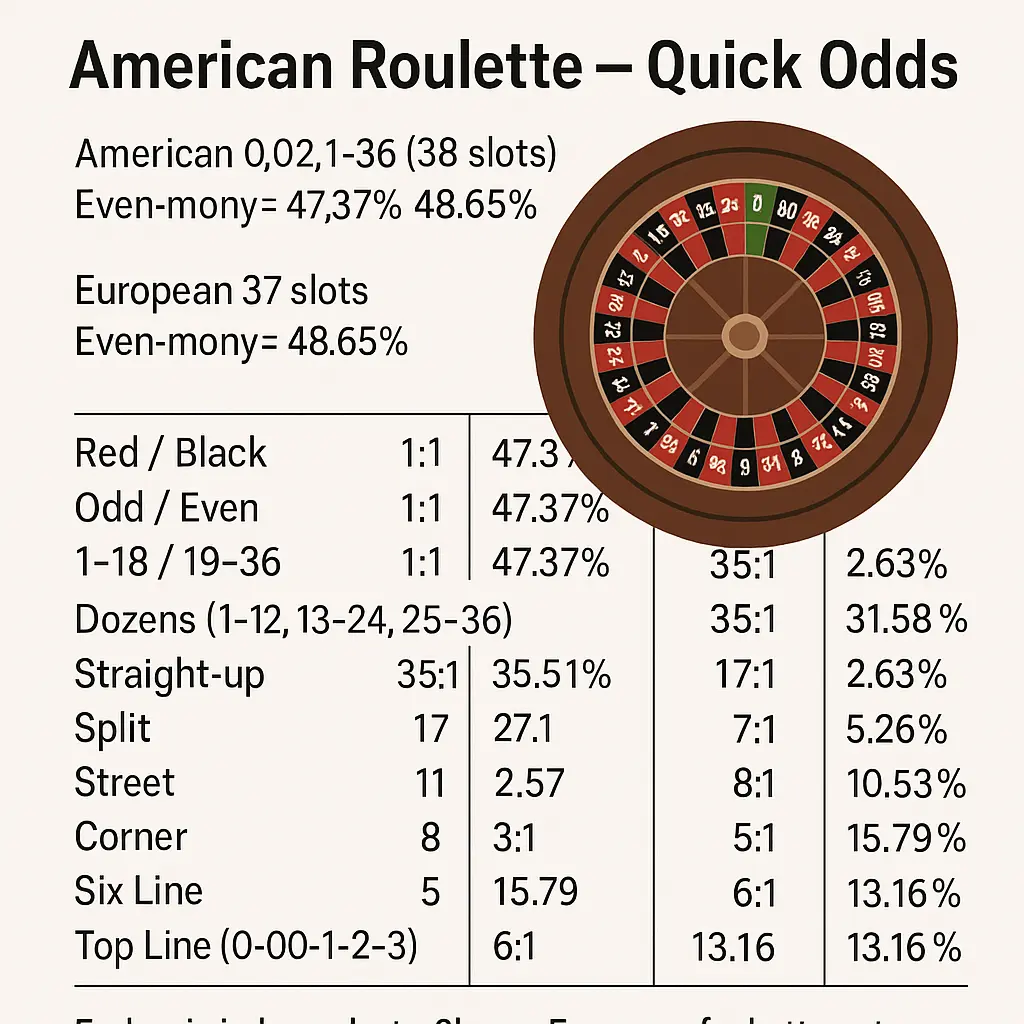
European Roulette: 37 numbers (0–36). On even-money bets the win probability is 48.65% (18/37).
-
American Roulette: 38 numbers (0, 00, 1–36). The extra “00” reduces the win probability on even-money bets to 47.37% (18/38).
Over the long run, European roulette is slightly more favorable for players.
American Roulette — Payouts & Win Probabilities
-
Red — 1:1, 47.37%
-
Black — 1:1, 47.37%
-
Odd — 1:1, 47.37%
-
Even — 1:1, 47.37%
-
1–18 — 1:1, 47.37%
-
19–36 — 1:1, 47.37%
-
1st Dozen (1–12) — 2:1, 31.58%
-
2nd Dozen (13–24) — 2:1, 31.58%
-
3rd Dozen (25–36) — 2:1, 31.58%
-
Straight-up (single number) — 35:1, 2.63%
-
Split (two numbers) — 17:1, 5.26%
-
Street (three numbers) — 11:1, 7.89%
-
Corner (four numbers) — 8:1, 10.53%
-
Six Line (six numbers) — 5:1, 15.79%
-
Top Line (0–00–1–2–3) — 6:1, 13.16%
Notes
Single-number bets offer the highest payout but the lowest hit rate. Even-money bets (red/black, odd/even, low/high) are steadier, but returns are modest. Because each spin is independent, relying purely on past outcomes (“patterns” or “roads”) isn’t reliable; without an edge, the house advantage will prevail over time. Still, by studying large samples, players sometimes summarize tendencies and adapt staking styles that suit them—but real-world results depend on disciplined application rather than streak