Baccarat can feel both simple and complex. Talk of “squeezing” cards, following roads (Big Road, Big Eye, Small Road, Cockroach), or tournament tactics can make it sound intricate. Yet at its core the game is binary: Banker wins or Player wins—like a coin flip where the two sides don’t pay the same.
In the classic game, Player pays 1:1. Banker also pays 1:1 but charges a 5% commission (bet $20, win $19). That small fee irritates everyone:
-
Dealer errors are more likely when calculating 5% commissions.
-
Game speed slows as staff make change with small chips.
-
Players feel short-changed: you win, but you “lose” 5% of the win.
The No-Commission Idea
In 1987, Rakesh Wadhwa introduced a version in Sri Lanka that removes commission on Banker wins. To keep the game balanced, one special rule applies:
-
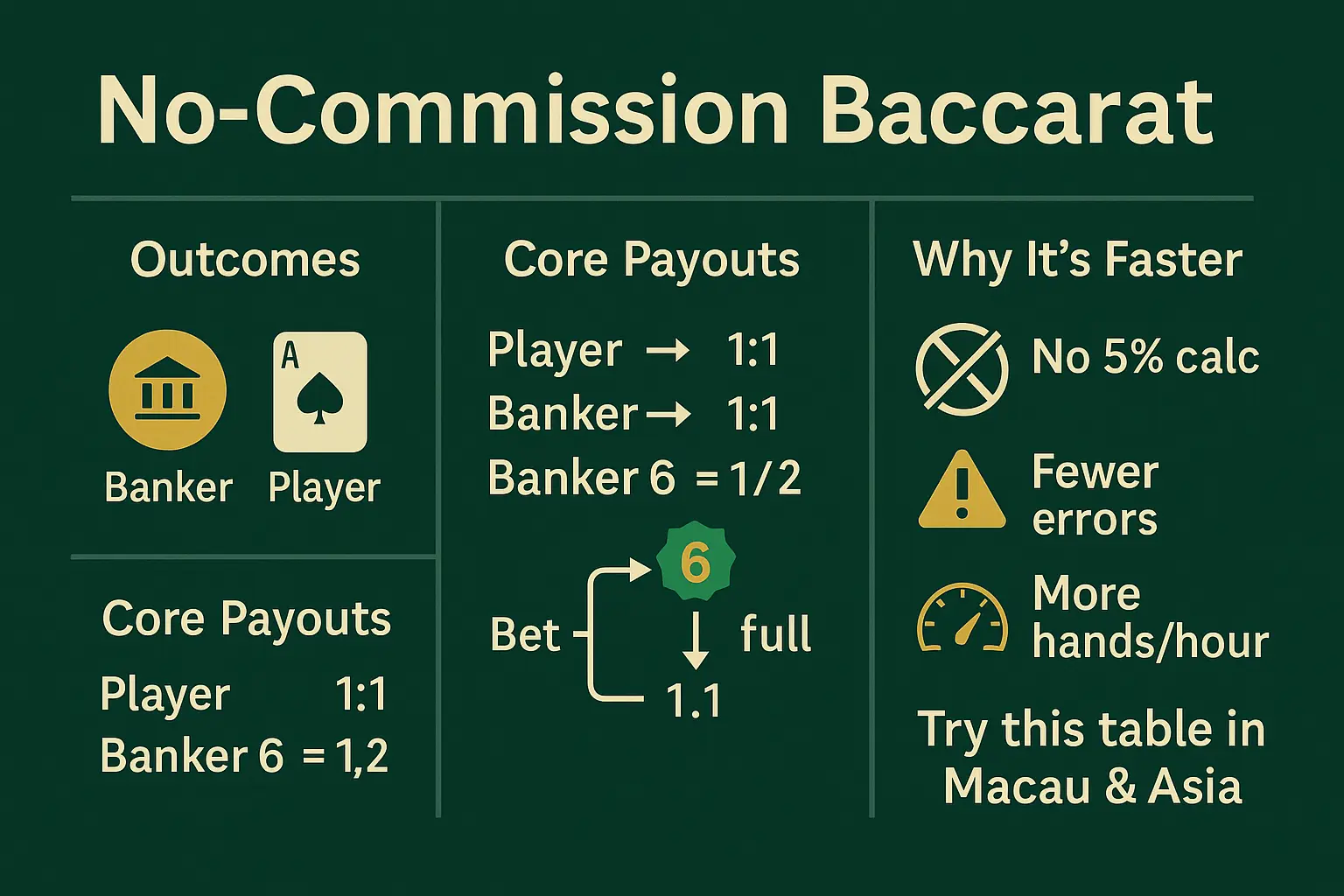
If Banker wins with a total of six, the payout is 1:2 (half-win).
In other words, the house takes a larger slice only on this specific result.
Practically, the casino takes 50% of the win on roughly one in ten Banker wins (about once in twenty hands overall), instead of 5% on every Banker win. All other Banker wins pay 1:1, the same as Player—with no commission. If you play a few hands and avoid the rare “Banker 6,” your returns are higher than at a traditional table because there’s no 5% haircut on normal Banker wins.
While no-commission baccarat often has a slightly higher long-run house edge than classic baccarat, you usually need days or weeks of volume before that difference shows up. For short sessions, the experience benefits are immediate: more hands per hour, fewer mistakes, no fiddly small chips, and most Banker wins pay the full amount.
How It Spread Worldwide
-
1987 – Sri Lanka: Launched at Palm Beach Casino; Indian players who frequented Sri Lanka and Nepal asked for it there, and the variant soon displaced classic baccarat in both markets.
-
1995 – Argentina: Consultant David Packer saw it in Nepal while working with Berjaya; the game reached Casino Iguazú.
-
Late 1990s – Uruguay & Australia: Spread to Conrad Punta del Este (1997). From there to Australia: Conrad Jupiters (now The Star Gold Coast) adopted it; executive Andrew McDonald later took it to Crown Melbourne, and it rolled out across Australia.
-
2000 – Malaysia & at sea: Visitors from Genting Highlands (now Resorts World Genting) carried it home; it then moved to Star Cruises (Hong Kong–based).
-
2000s – Macau & Asia: From the cruise network it crossed the Pearl River Delta to Macau and quickly spread across Asia.
Today, no-commission baccarat is common in Macau and throughout the region. Next time you sit down to play, consider trying the no-commission table: faster dealing, fewer errors, and full-payout Banker wins—except on Banker 6.