1) Foundations: What the Kelly Index Actually Means
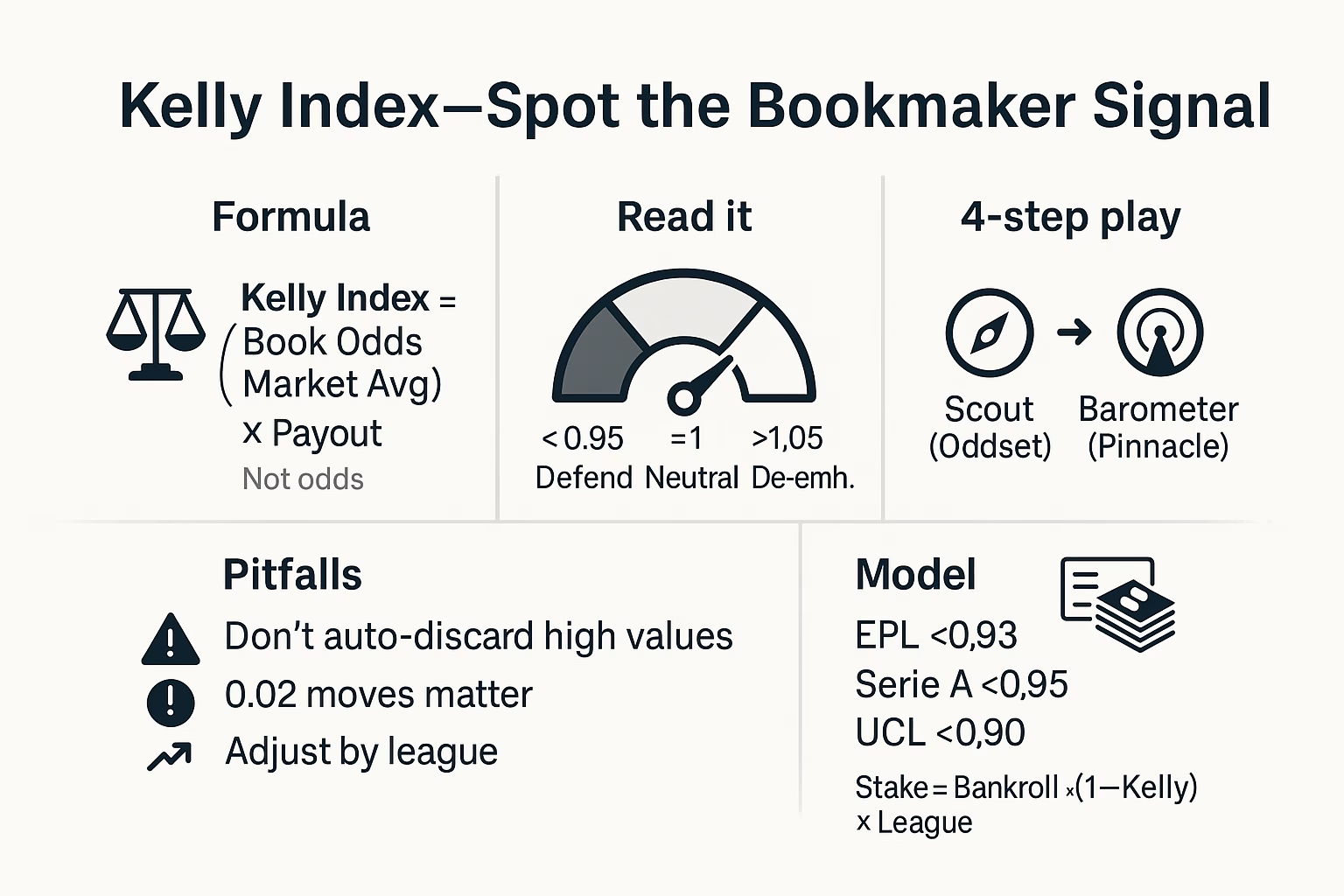
The Kelly Index ≠ the odds. It’s a risk-weighted indicator showing how a bookmaker prices an outcome relative to the market after margin and adjustments—not the same as the staking formula known as the Kelly Criterion.
Think of it this way:
-
Odds are the shelf price (e.g., apples at $10/kg).
-
Kelly Index is closer to the seller’s “true acceptability” price after costs and risk (e.g., the $8/kg floor where discounting below that hurts).
Core formula
Worked example
Match: Man City vs Liverpool
Market average odds: Home 2.00 / Draw 3.50 / Away 3.80
William Hill offers: Home 2.10 / Draw 3.30 / Away 3.60
Payout rate: 95%
William Hill’s Home Kelly = (2.10 ÷ 2.00) × 0.95 = 0.9975
How to read it
-
~1.00 → In line with market consensus.
-
< 0.95 → Book is actively defending that side (thinks it’s likelier than the market).
-
> 1.05 → Book is de-emphasizing that side (thinks it’s less likely than the market).
2) The Four-Step Process to Find the Right Angle
Step 1: Pick the right reference books—each has a role
| Role | Examples | Why it matters |
|---|---|---|
| Low-payout “scout” (higher margin) | Oddset (Sweden) | Often reveals what the book wants to protect. |
| High-payout market barometer | Pinnacle, Betfair | Best proxy for true market expectation. |
| Local intel | SNAI (Serie A), Macao (Asia) | Captures regional info and local money. |
Example (Premier League, Arsenal match)
-
Check Oddset Kelly for the bookmaker’s “floor.”
-
Compare Pinnacle for the market’s true lean.
-
Cross-check William Hill as a legacy UK benchmark.
Step 2: Vertical check—three outcomes at the same book
Case: 2023 Man United vs Chelsea (William Hill Kelly)
-
Home 0.93 / Draw 1.02 / Away 1.12
Read it
-
Lowest value is Home 0.93 → Book is most vigilant on the home win.
-
Draw > 1.00 → Higher potential payout strain if it lands.
-
Away highest (1.12) → Book rates away win as least likely.
Takeaway: Prioritize Home.
Step 3: Horizontal check—the same outcome across different books
Case: 2024 UCL Real Madrid vs Bayern (Home Kelly)
-
Oddset 0.88
-
William Hill 0.95
-
Pinnacle 1.02
Read it
-
Oddset the lowest (0.88) → Strong defense against the home win.
-
Pinnacle > 1.00 → Market shows some doubt about the home side.
Takeaway: Keep watching pre-kickoff moves before committing.
Step 4: Live-window tracking—the 2-hour gold zone
Case: Serie A AC Milan vs Inter
-
T-48h: Home Kelly 0.98
-
T-2h: Drops to 0.91
Read it: The book reduces exposure late, implying rising home probability.
Result: AC Milan 1–0.
3) Pitfalls New Bettors Must Avoid
Pitfall 1: Auto-discarding high Kelly values
Counterexample: 2023 Empoli 0–1 Atalanta (Serie A)
-
Balkan Bet Away Kelly = 1.24 (looks “impossible”)
-
But that book consistently posts richer prices → away win still landed.
Do this instead
-
Compare peers: If most other books show Away Kelly < 1.00, don’t discard the angle.
-
Check history: Suppose Balkan Bet’s last 10 matches with Kelly > 1.10 still saw that side win ~35%—you can’t ignore it.
Pitfall 2: Ignoring “tiny” moves
Counterexample: Dortmund vs Mainz (Bundesliga)
-
Oddset Home Kelly from 0.89 → 0.87 (a mere 0.02)
-
Final: 1–1 upset.
Do this instead
-
For low-payout books, treat > 0.03 move as a flag.
-
Combine with money flow: If Kelly falls but turnover doesn’t rise, it may be a decoy line.
Pitfall 3: One-league-fits-all logic
Counterexample: Applying EPL heuristics to Copa Libertadores
-
Brazil home side Kelly 0.85 (EPL logic: “safe home”)
-
Result: 1–2 upset.
Do this instead
-
Add a +0.05 risk adjustment for South American club competitions.
-
Cross-check local books (e.g., Betsul in Brazil).
4) Advanced: Build Your Kelly-Index Workflow
4.1 Dynamic thresholds by competition
| Competition | Low-risk band | High-risk band |
|---|---|---|
| Premier League | < 0.93 | > 1.07 |
| Serie A | < 0.95 | > 1.10 |
| UEFA Champions League | < 0.90 | > 1.05 |
4.2 Cross-validation triggers
-
Green light: Low-payout book < 0.92 AND High-payout book < 0.97 → historically strong hit rate (≈ 75%).
-
Red flag: Local book > 1.05 + surging handle → upset alert.
4.3 Bankroll sizing (rule of thumb)
Example
Bankroll = ¥1,000; EPL Home Kelly = 0.92; League factor = 1.0
Stake = 1,000 × (1 − 0.92) × 1.0 = ¥80
5) The Pro’s Mindset: Think Like a Book
At its core, the Kelly Index is about balancing risk.
-
Books balance flows: They guide money away from their pressure points.
-
Differences = information: If Oddset vs William Hill diverges by > 5%, someone likely has edge info.
-
Late moves don’t lie: The T-2h window is where intent shows up.
Field mantra
Low-payout books set the floor.
High-payout books show the wind.
Local books surface the whispers.
Late moves call the shot.
With this framework, disciplined newcomers can realistically lift a ~50% strike rate toward 65%+ over a few months. The Kelly Index isn’t a magic key—but it’s one of the best lenses for decoding how bookmakers think.